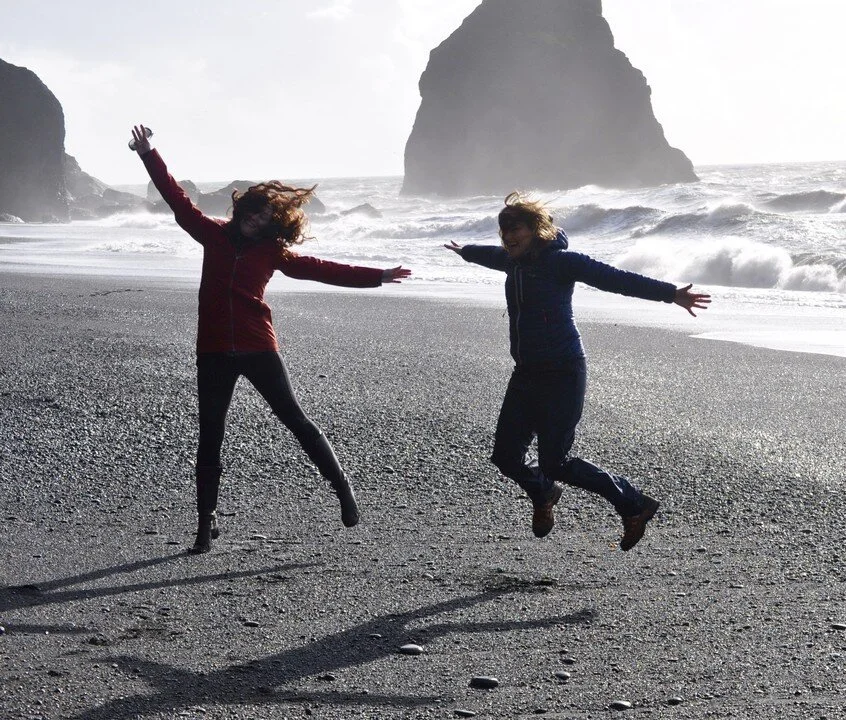
(Be) Longing

From there, not from there.

It’s home but it’s not my home. I feel a tingle in my arms, a tightness in my diaphragm.

What do I miss?


I miss the taste of salt on when I lick my lips. I miss being able to look out at forever. I miss the wind through my hair, feeling the sting on my face. I miss the connection to feeling that this place gave me. It felt like freedom and it felt like a place I needed to run from. And I did run, to the ends of the earth, as soon as I could.

The people part ruined it for me. At the time, I couldn’t see the good. Too many years of bad.

Not bad…horror.

Daily, hourly reports of the worst things that humans can do. My parents were, and are, news addicts. Not sure why. Maybe there was a need to know what was happening at all times? My dad would watch the breakfast news, the 6pm news, the 9pm news, sometimes the 10pm news, if he wasn’t asleep on the sofa.

If we were in the car, the news was always on. Actually, he had classical music on mostly, but on the hour he would switch to the news. And it was NEVER good. Ever.

Someone had been shot, someone had placed a bomb, someone was taking ownership for an atrocity. I never understood why they were so keen to claim it as theirs. Shouldn’t they be bowing their heads in shame? Shouldn’t they be sending themselves to a dark cave in the forest to banish themselves from the rest of us? How could they do that?

How?

Just so much hate. And in a life of daily horror, some were even worse. Shooting people at a funeral, a mob surrounding soldiers trapped in a car and tarring and feathering them. Omagh.

Omagh.

Rivers of blood running down the street.

Closer to home, my next door neighbor checking under his car with a mirror to make sure there wasn’t a bomb. Every morning, I’d see this from my driveway as I walked towards the bus stop for school.

Normal. normal. normal.

Normalizing fear. Normalizing pain. Normalizing destruction. People’s lives ruined in an instant.

I couldnt’ stand the humanity. So I left.

And now, I can see the beauty. The place itself. I didn’t allow myself to feel the irishness of it. To drop into the very essence of the land. The land got forgotten in the race to divide it.

As a protestant, growing up, I never felt allowed to be Irish. Plus my parents were from Scotland. Even more, you do not belong here. We were not taught Irish at school, unlike at the Catholic schools. We were sent to ballet lessons, Catholics to Irish dancing. You can not identify with the irishness of where you live. When I went to university in England, I was friends with some second generation Irish girls from Manchester who knew all the words to ‘The Fields of Athenry’, I had never even heard it. How could I be from there but not?

Living in America, I’ve lost count of how many conversations that start “Oh, you’re from Ireland??! My great grandfather was from there. We’re Irish!”. So keen to proclaim their irishness and me, so quick to clarify, “No, not Irish, Northern Irish”. A little less Irish. More British? More this weird, in-between ‘not allowed’ to be Irish. Like it felt like a false claim.

As I sink into this period of my life, I feel this pull towards the place and the land. Pride is not something I could ever allow myself to feel about where I came from. The shame of what was happening and had happened and how people had behaved was too loud. Drowning out the beauty.

But the land, the mysticism, the stories, the music, the call of seagulls, the rocks disappearing into the ocean as stepping stones to another land. The singing green of the fields, the newborn lambs in spring, the crumbly, moist feel of peat between your fingers. The soul cry of creativity, art, that hadn’t been mine.

And yet, it has shaped me into who I am. It swirls around me, like tendrils of smoke.

It’s calling me home.

The decisions that take you to where you are now.

Often in coaching conversations with my clients we work on something that the client really wants to do but hasn’t yet been able to succeed at. It could be anything from taking on a new role, to starting their own business, to moving to a different country. Many times, it becomes clear that the reason they haven't done the thing they want is driven by the fear of making the ‘wrong decision’. It holds us back, this worry that we might make a big leap and that it, or should I say, we, might fail. If we fail, what does that say about us? What will people think? What consequences could arise because of our failure? Listening to these voices in our heads, we stay stuck, not moving forward from a place of unhappiness, existing in a kind of limbo. Fredrick Hudson very eloquently talks about this stage in his excellent book, ‘The Adult Years: Mastering the Art of Self-Renewal’ as the ‘Doldrums’.

It can be extremely difficult to move out of this state of inertia and we can stay there for months or sometimes, even years. It feels easier or less scary to stay where we are than to move forward into the unknown.

One of the techniques I use with clients to help them shift into moving forward is ‘What if’ scenario planning which helps them reframe their issue in a positive way. Often people talk about all the reasons why things might go wrong if they make their decision.

‘What if the new company is worse?’, ‘What if I uproot my family and they all hate it?’, ‘What if the business fails and it costs us our home?’. All of these are totally valid and understandable concerns and it would be unwise to discount them altogether. However, we can tend to permit these negatives ‘What ifs’ more weight than they deserve.

To get out of this negative mindset, I ask them to consider the reverse: 

‘What if the new company is the most exciting place you’ve ever worked?’, ‘What if your family thrives in this new country?’, ‘What if your business takes off and you make more money than you had ever thought?’. Putting the client into this positive mind state, having them imagine the excitement of what that would feel like, can be a powerful motivator.

Another technique that often works is asking the following question in response to the negative ‘what ifs’:

 ‘Well, what if you stay exactly as you are right now?’

That answer to that question can often be the scariest one of all…

My personal philosophy in life is very much that you can’t regret any decision you make as they all lead you to the place where you are right now. You made them at that time with as much information as you could and they have served to teach you. Even if they have seemed negative you have grown because of them. They also serve to guide you the next time you have to make a similar decision.

To that end, I thought I’d share a few which have made a fundamental difference to my own life:

1) Studying Italian at University

This was a definite spur-of-the-moment-type of decision that I made at the age of 17. I had originally wanted to study History and French at university, but my small high school couldn’t accommodate those two topics in conjunction for “A” level exams. So, I decided to take Latin “A” level instead of French and then apply for a degree in History and Italian. I didn’t speak a word of Italian and I’d never been to Italy. I did know, though, that the course would let me spend an Erasmus year in Venice and the romantic in me was sold. This turned out to be one of the most fabulous and weird years of my life and I count myself very fortunate to have been able to immerse myself in this gorgeous city. Learning Italian also led me to move away from the UK straight after university and live in Milan for nearly six years. It opened up a world of tasty food, heart wrenching opera, beautiful countryside, amazing friends and so much more. I love being able to communicate in this beautiful language.

2) Leaving Italy


This one might seem a little strange given the previous one but definitely the hardest but most “right” decision I have ever made in my life. I was in a relationship with someone in Italy for nearly 6 years and had bought a house with them. This relationship made me grow up but wasn’t right for me by any stretch of the imagination. I lost my identity and became a small, sad person when I was with them. So, in the space of a couple of weeks, I made the decision to end the relationship, quit my job, move out of the house and leave the country. I moved to London with my all my belongings in a few suitcases, had no job or anywhere to live and no real sense of what on earth I was going to do. Luckily, I had good friends in the city and I found a great job and a place to live quickly. The next year was hard and I cried a lot but I didn’t regret if for a second.


3. Spending my house deposit on fixing my teeth and going on safari


This one still makes me laugh. I had a bit of money saved up when I moved to London and instead of wisely investing it in some kind of ISA/house deposit I spent it on myself. In my first year in London I did two things I had wanted to do for years but hadn’t ever done. First, I had veneers put on my top four front teeth. Years of dodgy orthodontic work had left me with ruined teeth and I never smiled fully in photos or in person. My teeth made me extremely self-conscious and I realized I could do something about it. So, I spent a fair bit of cash and went through a fair bit of pain but it was totally worth it. I now all am smiles in photos and it has made me way more confident.

The second thing I did was go on holiday for two weeks to Tanzania by myself. My ex boyfriend had never wanted to go anywhere adventurous with me on holiday because he would “have to protect me” (you can see why this didn’t work out…) and so to challenge myself I went to Africa on my own. The first week I spent on safari in an amazing place called Beho Beho and the second week I lived in a on a tiny island called Chole off the coast of Zanzibar. It had no electricity or running water and fruit bats flew through my bedroom at night. I met some fantastic people, saw some amazing sights and in a pretty cliched way “found myself”. It was a turning point in my life when I realized I didn’t need a partner and that I was very happy on my own.

4. Commit – get married and have kids

When you realize you don’t need someone, that can be when you meet the one who will change your life. Not long after the trip to Africa I met my now husband. He didn’t want me to change, he didn’t ask me to, he accepted me for who I was and made me want to be a better person for him. It didn’t take long for us to realize how serious we were about each other and we moved in together, got married and had our 1st child all within about 3 years. I am a self-confessed commitment phobe but marrying him and having our two gorgeous kids was the best decision I’ve ever made.

5. Going back to work after having my first child.

This was a hard one for me. I have always been very career focused and not particularly ‘maternal’ in my outlook. However, all that changed when I had my son. Suddenly, I had to question my priorities in life and think about whether my career was still as important to me. Should I stay at home and devote myself entirely to my son? It was a question I wrestled with for a good while and caused me many a teary, sleepless night. However, I went back to work four days a week when he was seven months old. I am not denying how hard it was at the beginning and I definitely hit a wall about two months in. I felt like I was a bad mum, a bad employee and just not doing anything well. Luckily my boss at the time made me realize that this was just a bump in the road (thank you, Francois). Working is part of who I am and whilst it wasn’t an easy decision, again it was definitely the right one for me.

6. Starting my own coaching business


Making the leap from a twenty-year career in corporate to starting my own business is up there with one of the hardest decisions I have ever made. I agonized and put it off for months, if not years. The ‘What Ifs’ were very strong in my head and I repeated them to everyone who would listen. ‘What if I’m a terrible coach?’, ‘What if, no one wants to pay me?’, ‘What if we lose our home?’, ‘What if I am a failure?’. So much fear around my very own identity was tied up in this. In the summer of 2018, I was made redundant from the company I had been at for 11 years. A potentially predictable step would have been to look for a similar role in another big company. Instead, I knew it was the right moment to take that leap into starting my own coaching business. The last two years have been a rollercoaster of trial and error, personal and financial growth and best of all, joy in doing something I absolutely love.

In sharing some of my own personal decisions, I was reflecting on what it took for me to make them. Fundamentally, it is a mixture of two things. Each time, in some shape or form, I armed myself with information. I wasn’t leaping off into the complete unknown. For example, I was with my husband for a couple of years before we got married and I invested in a serious coaching certification before starting my own business. This could be, what we refer to as, using my ‘head’ to guide me.

On the other hand, I had to fundamentally trust in myself to be able to deal with the unknown and whatever consequences came with that. I didn’t know if I would enjoy living in Italy or whether I would figure out the balance between my job and being a new mother. What I did know is that I would work it out. I followed my heart, I listened to my intuition. There is so much to be said for allowing yourself to be guided by what feels like the right thing to do. 

Moving forward with trust in yourself is incredibly freeing and when I see my clients decide to make those leaps it makes my heart sing for them. They get to move forward and that is what coaching is all about.

As always, I'd love to hear your thoughts.


Don't believe the hype about all introverts loving lockdown

When the world wide COVID-19 quarantine started there were various cartoons flying around which show extroverts being miserable about working from home and introverts being delighted. 

I kept looking at them and feeling like this just didn't fit for me. Yes, in a 'normal' world, as an introvert, I often was happiest in my own home. But there was something missing from this quarantine picture. It implied that the introvert was alone in their home!

My own working life before quarantine was very much by design. I left corporate life in summer of 2018 to start my own business as a coach. My business has been run out of an office in my home where I primarily coach nationally and internationally but via Zoom. One of the major deciding factors for me in this life choice because I was exhausted after spending 20 years working in a corporate office environment. The vast majority of my working life had been spent operating in an open space office design. Great for team building and creating networks, pretty dreadful for introverts. Towards the end of my corporate life, I found myself spending time hunting down tiny, unoccupied ‘quiet space’ rooms on my campus to be dismayed when they would already be occupied by someone. This was happening more and more, so much so that sometimes I would go out at lunch and just sit in my car in the parking lot.

One of my mentors at the time, himself a massive extrovert, was constantly telling me to be more vocal and assertive. He even suggested that I buy a book called ‘Quiet: The power of introverts in a world that can't stop talking’ by Susan Cain. He had bought it for his wife who was an introvert and she liked it. Ummmm…of course, she liked it. She’s an introvert. I read it and then, essentially, wanted to throw the book at him. It seemed pretty obvious that he had not read it himself because he was still operating from a point of view that being an introvert was a ‘bad thing’ and I needed to 'fix' that. Society often portrays introverts in a negative light. There's the weird girl who is going to end up alone like a crazy cat lady. The anti-social nerd who prefers the library. The cold person who doesn’t ‘like’ other people.

Nothing could be further than the truth for me. I love people, I find them fascinating, I can’t stop trying to understand them. The very profession I chose, being a coach, is based upon my love of other people. And…..I chose how I wanted to engage in that. I chose to work from home and mostly coach via Zoom. I chose to be alone in my house for 6 hours a day and work in that environment. I reveled in the uninterrupted silence. I breathed a sigh of relief when I would drop the kids off at school and walk back into a quiet, empty house. I delighted in having space and peace to ground myself before going into an immersive, deep conversation with my clients. I was a much happier and productive person.

And then Covid happened. All of a sudden, my quiet, peaceful house had 3 more people in it. All.the.time. My husband and my two children aged 9 and 11. Now, I love my family. More than anything in the world. I even have their initials tattooed onto my body. That’s how much I am committed to my family ;-). 

See.

But…. I’ll be completely honest, I don’t like having them around all the time. I just don’t. I need my space. Wanting to be alone does not mean that you don’t want to be with someone. It just means that you don’t want to be with them every single second. It doesn’t mean you love them less. When I get my space, when I get to recharge my batteries in the silence, I come back a happier, more loving person for everyone.

So, for me, the last 6 months (and the foreseeable future) have been and are challenging. I do count my blessings and am very much aware that many, many people are in much worse situations than I am. In the grand scheme of things, this is small potatoes. I also know that everyone has their own reality that they deal with. This is mine.

My family and I are trying lots of things in order to make the space and the situation work for everyone. I was lucky enough to be able to convert a room in the house into a new office for me after my husband took over my original one. However, even a space with the door closed doesn’t mean that I get the same peace and quiet I had before. I can hear 3 zoom meetings going on at most times, other people’s voices and conversations. The type of work I do means I am not ‘talking’ to people all the time. Often, I am studying or writing notes or reflecting on something that came up in a session. I am silent when I am doing that. To my family, that means they sometimes think I am not ‘working’. In our society, working means meetings, means being in conversations with other people. If they don’t hear that sound it means that it is ok to come in for a chat, to ask for a snack, to be hang out. And because I love them, I stop what I am doing and engage. Then I notice that I feel irritated and have to reset and restart. Not because I am a freak of nature but because I am an introvert.

I am also realizing that I need to set clearer boundaries. Part of that is being very clear on what I need and part of that is helping other people to realize that I am not rejecting them. Just as it is not ok to make an introverted person feel guilty or wrong when they express that they need to spend some time alone, it is also not helpful to suddenly distance yourself away without giving any explanation.

Case in point: I came up with what I thought was a great solution this morning. I created a sign for my office door, a similar concept to the ‘Do not Disturb’ sign on hotel door handles. As I was putting it up on the door, both of my kids came to see what I was up to (ironic..). The reaction when they saw the sign was akin to dismay. ‘But why do you need that? You are not working when you are in there…..’. And that is exactly the point. We have these definitions of what ‘work’ looks like and it made me realize that I need to sit down with them and explain more what my work involves. They are super smart kids, they will understand it.

I don’t have the perfect solution for this unusual place we find ourselves in and I know I have to work as much as anyone to help figure it out. I have an amazing, loving and understanding family and we will figure it out together. To that end, I asked my husband to read this article before I published it. He is a self declared extrovert. He made the point that sometimes extroverted people experience some of these situations and feelings too. I guess that is exactly what I am attempting to get at here. We all make assumptions about how other people are and what they need and why they are acting in a certain way. Sometimes we base those assumptions on labels that we give people or that we, ourselves, take on. We need to check in with the people around us periodically to test if these assumptions are (still) true.

Here are a couple of suggestions based on my own coaching experience that I have found useful:

If you are not naturally introverted, please remember that you might be unknowingly and unintentionally draining someone’s energy. Know that if they want to spend time alone, they don’t love you any less. Talk with them about how to create as much space and quiet for them as possible.

If you are introverted, please know, first of all, that there is nothing wrong with you. However, sometimes you have to speak up for what you need. Other people are not mind-readers so it helps to explain what is going on inside your head. 'I'd love to spend time with you in a hour and right now, I need some peace and quiet to get on with something'.

As for me, I am going to keep my sign up. If you have any other tips or ideas, I’d love to hear them.

Quietly, of course.

Can you "KonMari' your career?

You'd have to be sleeping under a rock right now to escape the wave of decluttering that is infiltrating the UK and the US (and beyond). Instagram and Facebook feeds, following the launch of 'Tidying up with Marie Kondo' on Netflix, are full of pictures of giant piles of clothes on beds, immaculate closets and scores of garage bags heading off to donation centers.

The compelling tv series is a follow up to Marie Kondo's best selling book, 'the life-changing magic of tidying up. If you haven't read the book or seen the show, the premise is that we are surrounded by too much clutter in our lives and it is detrimental to our ability to evoke a calm mindset. Her straightforward method involves examining each possession that we have and changing the way we evaluate them. Instead of justifying possessions by criteria like sentimentality, monetary value and practicality, she has us ask one a simple question: 'does it spark joy?'. If the answer is yes, the item should stay and remain a prized possession. If the answer is no, then it should be donated or discarded. There is a pretty good guide to how to implement this in your home here at Happy DIY Home

Is it possible to apply the same simple methodology to our work space as well as our home space?

In a coaching session with a client this week we were dealing with a pattern of acute overwork and the related stress that comes with that. This person had been working 16 hour days for months. feeling that they weren't able to focus on the things that they really cared about and even worse, was nearing exhaustion. For some people it can be hard sometimes to say no to meetings or requests when they can all seem important and relevant. Talking in the hypothetical about the concept of prioritizing and saying no wasn't really helping, particularly when the client was feeling so overwhelmed.

I happened to mention earlier in the session that I had been watching Marie Kondo's show and had a bit of a random idea to see if we could apply it in the moment. I had her open up her work calendar and we started with looking at a typical day from her current week. Without telling me anything about what the meeting was about, I had her read each one aloud and tell me if it had 'sparked' joy. The initial responses were fairly typical like 'well, not really BUT it was important because....' and 'this type of meeting is not supposed to spark joy!!'. However, we pushed forward to see if we could do it by simply answering 'yes' or 'no'. We then repeated this for every day in her past week; Monday, Tuesday, Wednesday, Thursday, Friday. The whole exercise took less that 10 minutes.

Where she had said 'yes' to a meeting, I asked her what she had been doing in that meeting. What became rapidly apparent was that there were 2 clear types of leadership activity that she genuinely loved doing and where she had been most productive AND had driven the most impact and action.

We had a moment of just sitting looking at each other and saying 'huh, well that is interesting'.

Now, in no way am I suggesting that it is entirely possible to ditch all the stuff in your work day that doesn't bring you joy. It would be awesome but not entirely realistic. However, it would appear that an exercise like this can be extremely useful in identifying where your energy should be best placed.

The areas where you had a super clear 'Yes' are the areas of your day and your role which should remain as your prized possessions and where it would be worth over indexing in terms of energy.

The areas where the answer was a resounding 'No', how about asking yourself 'Is this something that could be delegated or given to someone in the team who genuinely loves this type of activity?' This correlates with the idea of donating in Marie Kondo's method. Just because you don't love something doesn't mean that is not valuable, it may just mean that it should be someone else's to love.

I also have a feeling that there might be some people who would do this exercise and realize that nothing in their work week had sparked any joy! There's an excellent moment to ask yourself if you are in the right role or the right company or the right career.

Would love to know what you think about trying out this idea and how it worked for you if you did.